Wednesday, November 30, 2005

Post Guernica now!


Art has power. Here is how much:

John T. Unger, an artist and longtime commenter on Collision Detection, recently announced an intriguing art project called "American Guernica: A Call for Guerilla Public Art". He's calling upon artists nationwide to post replicas of Guernica, Picasso's famous antiwar painting, on billboards and the sides of buildings(...).

Why Guernica? Because Picasso intended it to depict the horrors and insanity of war, particularly the human destruction wreaked by bombings. Guernica caused a stir when it was unveiled back in 1937, and apparently it still does. John says his inspiration for the project came from an Iraq-related incident, as detailed by Wikipedia:

A tapestry copy of Picasso's Guernica is displayed on the wall of the United Nations building in New York City, at the entrance to the Security Council room ... On February 5, 2003, a large blue curtain was placed to cover this work, so that it would not be visible in the background when Colin Powell and John Negroponte gave press conferences at the United Nations. On the following day, it was claimed that the curtain was placed there at the request of television news crews, who had complained that the wild lines and screaming figures made for a bad backdrop, and that a horse's hindquarters appeared just above the faces of any speakers. Diplomats, however, told journalists that the Bush Administration leaned on UN officials to cover the tapestry, rather than have it in the background while Powell or other U.S. diplomats argued for war on Iraq.

As John writes, "If the painting intimidates warmongers into covering it, then why not make sure that it goes up in as many public spaces as possible?"

Well, I don't have the resources to put one up on a billboard, but at least virtually, I make my statement, and encourage others to do the same. And, scarily enough, although in this case I might not physically be in America, it really doesn't make much of a difference, does it?
(via)

Tuesday, November 29, 2005

Spiral Jetty up close


If you look from a distance,
From Rozel Point, the Jetty is just a doodle on the landscape. It is art as ornament, Smithson-made bling-bling for Mother Nature.
(- Tyler Green)

But if you come up close,

You also begin to see that the entropy at work here at Spiral Jetty is not all natural. There is evidence all around that people are using the site in ways that will lead to its disintegration over time. People (probably men based on the expressionistic traces left) have pissed all over the work--on the sides of the boulders, on the top of the jetty, and (most prominently) right at the tip of the spiral--staining the white salt yellow. There are several piles of shit on the jetty and on the hard salt surface around the piece. At the tip of the jetty someone has left what was probably once a small sculpture made of modeling clay. It's now disintegrated into a puddle of red, blue, yellow, and green mush that looks like a melting scoop of Superman ice cream. There are cigarette butts on the jetty and empty cans at its base.
(- Todd Gibson)
Couldn't we consider this part of the artwork? Here is a comment by the photographer who took the above picture, Chas Bowie.
...when I was there making the afore-linked photo, previous visitors had piled a collection of rocks taken from various points on the jetty and piled them at the tip of the line, creating a sort of nipple at the end, which stacked to about a foot higher than the rest of the jetty. I couldn't imagine caring enough about the Jetty to drive all the way there, only to add your own stupid little touch at the end. It reminded me of the old Steve Martin bit in which he travels to France, and describes basking in the awe of a glorious cathedral, drinking in the stained glass windows and architecture—only to pull at a can of spray paint to leave a dopey tag behind. Needless to say, I dismantled the distracting little pile (those rocks are indeed heavy).

I'm not sure it's that simple. The very way the work was made, its placing, context, character, all incite a dialogue. We are out of the museum here, and out of the socially binding cultural context of "art". And that was one of the points Smithson seemed to be making - introducing human intervention into a domain where normally it wouldn't be considered appropriate, at least not as an artistic act. One could say: leave the beautiful Salt Lake alone. It doesn't need your silly, megalomaniacal twister.

Monday, November 28, 2005

Figure, out

Art-of-Focus

Michael Takeo Madruger's net art works on Turbulence are calm, seemingly monotonous. They fear focus as dates fear the morning - it takes away the clarity of feel. Some of them are quite political, others personal, all of them seem to play with our ability to see - or rather, to almost see. (there is a wonderful Portuguese verb for that - "vislumbrar" - to appear in an unclear way). Re_collection is one of them, a short piece where "nothing" actually means a lot, where every pixel fights for expression - until they manage. Don't waste too much time reading the project description - at least not before you see it.

Saturday, November 26, 2005

Another Polish controversial art scandal

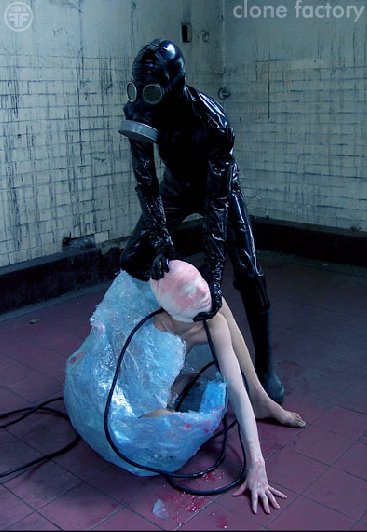
I have never seen the Polish performance group Suka Off live. Which means I am not a very comptent person when it comes to judging their shows.
But several influential people in Poland recently decided that it really doesn't matter. If you know the story, or have seen a picture or two, you basically can decide if something is respectable, or, as has been in the case of Suka Off, if it's just "disgusting pornography" and should be burned down, destroyed, killed and rot in hell, where it belongs. It all started with an article in the tabloid Fakt, which stated "They call this disgusting stuff art!" and "This is pure pornography!". The journalist didn't see the show - but saw the pictures. Then, a politician read the article, and decided it was time to do something about it. He didn't see the show, only read the article. And he put the case to court, declaring it a case of "distribution of pornography" (illegal in Poland). Some other politicians felt the need to confirm the hienous nature of the show. A few old, renowned directors said how horrible this was. One of them, Hanuszkiewicz, used to make scandals himself, putting motorbikes in the National Theater (in the middle of the comunist era!), and such. Now he's old and his productions are aweful - but he is the perfect "judge" of the situation.

The next day after the original article appeared, Suka Off got dished from the program of an alternative theater festival. Its director now says it was for "financial reasons".
I will not write about the originality of the show, or the lack of it, for that matter. I don't know much more than a few descriptions (imitating fucking, pissing, hurting oneself). I like the pictures, though have seen not-too-different ones before. It could be as good or as bad as anything, but damn it, it's there, and it's the 21st century or so they say, and Poland looks like a joke. A sad joke.
Suka Off have self-censored their pretty site as a form of protest. (you can see it through here though - in Polish)

NB: It's amazing how short-lived people's memory of live (performing) art is. And to some extent, it is natural, since they really did not see the Abramovićs, the Gina Panes, Chris Burdens, or the viennese actionists. Is that another reason why history repeats itself? Because it's not film?

Tuesday, November 22, 2005

Bad gender art?

I've been thinking about my last post. What do I actually think of this feminist art revival? The question is: can we judge it as good or bad art? Why does it appear to be an ethical and not aesthetic choice? I mean, say I appreciate this type of art. Could I still consider one of these works bad art? The critics, all of them, don't seem to give me that choice: either you are avant-garde and therefore love it, or have another system of values which disqualifies this art altogether. This is a very irritating phenomenon that also happens in other forms of artistic expression where important life values are at stake. It is as if the issues were so important, the art part of art is nearly irrelevant. That's a pity - because the quality of a work not only goes beyond its concept (that's trivial), but also engages the spectator in a specific way. This engagement, this relationship, is what I might call quality, and it is what seems to matter no less than the "intention" or "concept" or so. The spectator could be a hypothetical one, but he is still part of the works dialogical being, so to speak. From the works shown below, I find Kozyra's piece stronger than Żebrowska's, because it goes deeper, on more levels, and it attracts me aesthetically, whereas Żebrowska's work, not for the first time, I find discomforting, almost unappealing, as in - weak. I can very well imagine a cross, a penis, and some other forms sliding out of a vagina, and they would seem to "work" - but there is something just too simple about it, naive, one-sided. Kozyra, on the other hand, manages (once again) to keep the balance in her ambiguity. She confuses us, makes us shake our heads, and then answer, and then ask again. And it's this constant coming back to a question I particularly appreciate.
And yet, once again I ask: is this sort of art fair?