Friday, June 16, 2006
The No.8 Wire - Issue 69
Gondwanaland Ministry of Culture Artists' Information Bureau ************************************************************************ An Electronic Alert for 1271 of Wellington's Creative People ENDNOTE 1: Remarks at the WCC Maori Community HuiENDNOTE 2: Bruce Mau's Incomplete Manifesto for Growth To submit your news, project details, call for participation, or cultural item of any sort, please

Thursday, June 15, 2006
Pole
 Marcin Maciejowski, Emmigrant, oil on canvas (2006)
found at this great Polish blog about art, where you can discover some excellent contemporary works by artists both Polish and foreign.
Technorati
Tuesday, June 13, 2006
Night-Seeing
Here, have some Bill Henson.


If there were only darkness in the darkness, we would never look into it, would we?


If there were only darkness in the darkness, we would never look into it, would we?
Technorati:
Objective criticism
A judge is not allowed to take a case if he knows personally the one he judges. Shouldn't it be the same in art criticism?
But then, how would criticism be possible, if the critic is everybody's (quasi) friend? And, after all, social life is, many would say, crucial to the art world.
If this is the case, the reviewer should clearly state his relation to the reviewed (e.g., degree of intimacy, number of conversations in the last week, month, year, common friends, social events both attended, etc.). I mean this quite seriously. This would also allow the reviewer to write more objectively, without worrying about the pain of hurting the ones we care about (and whatever you say, a bad review can hurt). It would make things clear: everyone knows about us, so I simply can't promote you. I can advise you, help you, work with you. I can listen to your explanations (which is already a great advantage you have). But this is where it stops.
And if it doesn't, if you resist everything but the temptation to "help" your friends, at least things are a little clearer for the public that is not in.
But then, how would criticism be possible, if the critic is everybody's (quasi) friend? And, after all, social life is, many would say, crucial to the art world.
If this is the case, the reviewer should clearly state his relation to the reviewed (e.g., degree of intimacy, number of conversations in the last week, month, year, common friends, social events both attended, etc.). I mean this quite seriously. This would also allow the reviewer to write more objectively, without worrying about the pain of hurting the ones we care about (and whatever you say, a bad review can hurt). It would make things clear: everyone knows about us, so I simply can't promote you. I can advise you, help you, work with you. I can listen to your explanations (which is already a great advantage you have). But this is where it stops.
And if it doesn't, if you resist everything but the temptation to "help" your friends, at least things are a little clearer for the public that is not in.
Technorati:
Jerôme Bel by Pichet Klunchun by Jerôme Bel

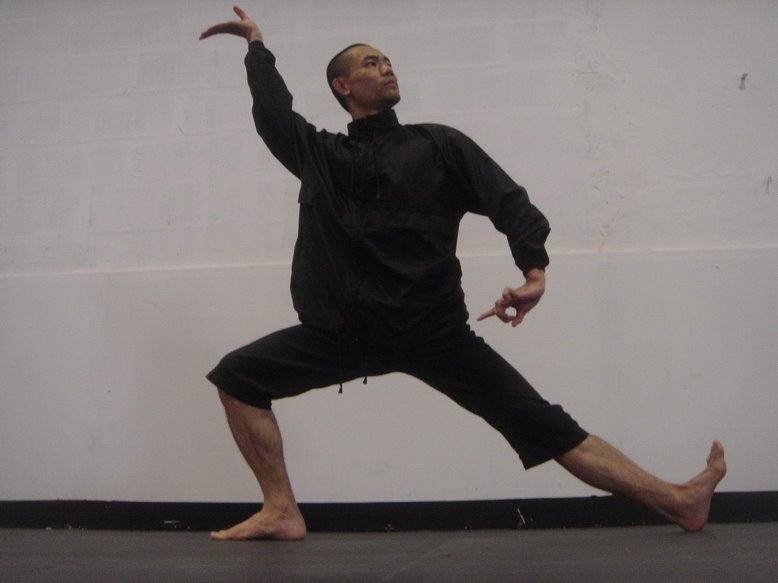
Pichet Klunchun and Myself, a performance directed by Jerôme Bel, at the Alkantara Festival in Lisbon
Is it really that simple? Dancer X meets dancer Y, asks dancer Y some questions, dancer Y demonstrates, than vice versa, dancer Y interrogates dancer X... and you have a show?
Almost.
Jerôme Bel, the master of entertaining conceptual performance (that some still call dance), seems to like simple formats: dance to (pop) music (The Show Must Go On), discover the body (Jérôme Bel), explain what you do (Isabel Torres). This time, the idea is of a meeting. Two people from different cultures, unknown to each other, meet. They sit down and ask each other questions about who they are and what they do and why they do what they do.
For some time, it might seem like a TV program. Pichet Klunchun, a Thai traditional dancer, tells his story and his art, he explains the basics of his work, and translates the complex vocabulary of Khon, an incredibly formal dance theater. Just a few elements distinguish this from a talk show: the attitude of Bel - respectful and purposefuly ignorant (the only element on stage besides two chairs is Bel's laptop), some very carefuly prepared answers and actions. Bel asks well. Almost as if by chance, the topic becomes death. Klunchun's incredibly slow and formal dance entry, showing one of the ways they represent death in Khon, is one of the shows most touching moments.
Another is the Thai's reaction to Bel's presentation of how he dies on stage. Because - you guessed it - the roles switch and now it is up to Bel to show the power of his art. Klunchun asks apparently innocent questions, Bel gives apparently silly answers. Klunchun is suprized, but accepts them and appreciates them. And somehow convinces us, through this strong, deep reaction, than there is more to Bel's provocative on-stage attitude (he openly admits he provokes the public, because they'll pay for the ticket anyway) than just provocation.
It is a beautiful meeting. There isn't a sign of interpretation, it all looks fresh and honest, nearly genuine. The show-and-tell format allows us to feel comfortable, as if the show went on and off, giving us plenty of room to think or just be comfortable. Of course, that is also the idea behind talk shows and circus: show a little, talk a little, don't make it too hard on the audience. But that is something I can live with. I much prefer this to actually trying to make it too hard on the audience which is so often the case. We are simple people, we see the show once, we don't know you and are unsure if we want to know you - don't scare us away too fast, please.
If there is something I found less convincing, it was the manipulative and somehow stereotypical way of seeing this meeting. Here is what I mean. Klunchun is Thai and dances a traditional Thai dance. But he says himself that he has lived in the West for many years and studied Western dance. And, although he claims he "didn't understand it", from his questions one could deduct he simply didn't understand a single thing, or lived isolated from the world. They are questions of a traditional Thai dancer, but I'm not sure such a dancer actually exists, let alone in that theater. It seemed more like Bel needed a somewhat naive, innocent character, asking the simple questions, so he could explain what he did. And that's a pity, because it would be quite fine if Klunchun simply admitted he will ask some questions from the traditional Thai point of view, as apparently he became interested in this perspective once again (in real life, that is).
Another question, which has been bothering me in several other performances, is the convention of "first time meeting". Why should we accept it, if we are to assume they are being honest? Isn't this cheating, as in, not admitting that you're not being genuine, you are reproducing something? But what alternatives are there?
Technorati:
Monday, June 12, 2006
Cláudia Dias - performing on this side
This is me. I am here. On my side. Giving you and idea of what my side is. Presenting it as well as I can, with what I have around me. I am no painter, my life is not filled with oil paint, or watercolor. Or clay, for that matter. It is filled with toothpaste and cigarettes and matches. This is what I know, and this is what you know. It is our shared vocabulary.
So I build my stories with our common vocabulary. I tell you about what I know best, about the things I specialize in - my town, it's places, it's memories.
This is pretty much a summary of Cláudia Dias' Guided Tour, a performance shown during the Alkantara Festival. A beautiful performance. One filled with the unpretensious poetry of storytelling. And this is the storytelling I most crave: one absolutely devoid of any trace of interpretation, of dramatization, of anything not belonging to the person that's in front of me on the stage. When Cláudia Dias says I am here, on this side. For you, of course, it is that side, but for me it is this side, we know she speaks about the part of the city (across the river) she lives in and will go on to talk about. But she is also talking about where she is at that very moment - on the stage. And the only thing that's different between her and us seems to be this little word: that.
Which is exactly why she seems so close: she knows the distance. She doesn't pretend it's not there, but doesn't make a great fuss out of it. She simply moves, paints with her household appliances, and makes her painting, for us, the onlookers, the curious tourists, the ever unsatisfied voyeurs.
So I build my stories with our common vocabulary. I tell you about what I know best, about the things I specialize in - my town, it's places, it's memories.
This is pretty much a summary of Cláudia Dias' Guided Tour, a performance shown during the Alkantara Festival. A beautiful performance. One filled with the unpretensious poetry of storytelling. And this is the storytelling I most crave: one absolutely devoid of any trace of interpretation, of dramatization, of anything not belonging to the person that's in front of me on the stage. When Cláudia Dias says I am here, on this side. For you, of course, it is that side, but for me it is this side, we know she speaks about the part of the city (across the river) she lives in and will go on to talk about. But she is also talking about where she is at that very moment - on the stage. And the only thing that's different between her and us seems to be this little word: that.
Which is exactly why she seems so close: she knows the distance. She doesn't pretend it's not there, but doesn't make a great fuss out of it. She simply moves, paints with her household appliances, and makes her painting, for us, the onlookers, the curious tourists, the ever unsatisfied voyeurs.
Technorati:
Friday, June 9, 2006
Intimacy
impressions on Dani Lima's performance «Estratégia no 1: entre» at the Alkantara Festival
How close is too close? Say we're alone, just me, the spectator, and a performer. Say she holds my hand. Say she speaks gently behind my ear. Say she walks me through her world. Say she makes me share who I am. Is this too close? Is it too close to be a performance? Too close to be good? Too close for what? To keep the distance? To judge?
Is it too close if I let her? Of course, at first, I resist, feeling manipulated, cheated, as if I were the one making a performance for the performer. But it's not the case. My participation is only necessary to make me feel there is actually something between us. A relation. A shared experience. A picture. A recorded sound, a discovered paper or cell phone. A broken tooth.
entre is a performance. It is a performance in that it is a meeting of two people. One of them knows more than the other. One of them is a guide. The other is the guest. S-he walks through this ever-unexpected space. Accompanied. Walking into the one that guides.
entre comes as close to an encounter as one gets. You touch, but above all - you are touched. I'm glad they replaced the original title, which was Please, Choose. It is not so much about chosing, as it is about entering. Or about being chosen, about being touched. You are manipulated, laid on the ground, put into corners, on a chair, in a closet. You are being manipulated into believing there is an actual world. This is the actual world. And there is proof: this is the perfomer's real photo. This was really her grandmother. This was her real love story. This is her real smile in reaction to your answer.This, here, is a real living space you will visit. With real people saying hello, as I listen to some beautiful, melancoly music on the earphones (I chose the walk to be accompanied by music). Melancoly. The feeling accompanies me, haunts me, doesn't let go. As if I were visiting some other life, some potential life... Yes, memories of a potential life. With it's potential distances, gestures, smiles and beings. One being, that is. One person. That somehow evades me, that has a schedule, a hidden agenda. That is a performer, after all. But what do I care, as long as there is something else to discover. As long as I am being enchanted, as a spectator should always be. Does this mean I'm passive? I suppose that depends on me. Not being exactly of the passive type, I answer, I refuse a thing or two, I inquire. I act as if. As if I weren't really a spectator, as if I actually had a choice, as if I weren't manipulated into something that will not allow me to judge, to see clearly. And that's fine with her: she answers, reacts, smiles, laughs. She is a person. And that's why she is in control. And why I trust her. Until, all of a sudden, she's gone.
And that is so eerily alike to how it happens, when a person goes.
Thank You, Dani.
PS.: One thing bothered me. This is an elitist performance. It requires the knowledge and acceptance of a set of conventions. Contrary to what it might seem, anything doesn't go. More than that: you have to accept what happens, or very little actually will happen. Also, these rules go beyond the most basic, like sitting or respecting the performer. It simply doesn't seem to allow the freedom it claims to give. Especially in the parts that have more to do with the performer herself executing things. And that is a pity - as if the meeting were sometimes interrupted by fairly formal exercices, things that have more to do with the old-style hermetic performance art style than with the open and magical world that is being open. On the other hand, the festival director Mark Deputter told me in the original version (he saw the premiere in Brasil just a short while ago) there was even more of that. Hopefuly, they will keep cleaning it, focusing on the discovery of the relation with the spectator. And I hope this spectator will some day be me again.
How close is too close? Say we're alone, just me, the spectator, and a performer. Say she holds my hand. Say she speaks gently behind my ear. Say she walks me through her world. Say she makes me share who I am. Is this too close? Is it too close to be a performance? Too close to be good? Too close for what? To keep the distance? To judge?
Is it too close if I let her? Of course, at first, I resist, feeling manipulated, cheated, as if I were the one making a performance for the performer. But it's not the case. My participation is only necessary to make me feel there is actually something between us. A relation. A shared experience. A picture. A recorded sound, a discovered paper or cell phone. A broken tooth.
entre is a performance. It is a performance in that it is a meeting of two people. One of them knows more than the other. One of them is a guide. The other is the guest. S-he walks through this ever-unexpected space. Accompanied. Walking into the one that guides.
entre comes as close to an encounter as one gets. You touch, but above all - you are touched. I'm glad they replaced the original title, which was Please, Choose. It is not so much about chosing, as it is about entering. Or about being chosen, about being touched. You are manipulated, laid on the ground, put into corners, on a chair, in a closet. You are being manipulated into believing there is an actual world. This is the actual world. And there is proof: this is the perfomer's real photo. This was really her grandmother. This was her real love story. This is her real smile in reaction to your answer.This, here, is a real living space you will visit. With real people saying hello, as I listen to some beautiful, melancoly music on the earphones (I chose the walk to be accompanied by music). Melancoly. The feeling accompanies me, haunts me, doesn't let go. As if I were visiting some other life, some potential life... Yes, memories of a potential life. With it's potential distances, gestures, smiles and beings. One being, that is. One person. That somehow evades me, that has a schedule, a hidden agenda. That is a performer, after all. But what do I care, as long as there is something else to discover. As long as I am being enchanted, as a spectator should always be. Does this mean I'm passive? I suppose that depends on me. Not being exactly of the passive type, I answer, I refuse a thing or two, I inquire. I act as if. As if I weren't really a spectator, as if I actually had a choice, as if I weren't manipulated into something that will not allow me to judge, to see clearly. And that's fine with her: she answers, reacts, smiles, laughs. She is a person. And that's why she is in control. And why I trust her. Until, all of a sudden, she's gone.
And that is so eerily alike to how it happens, when a person goes.
Thank You, Dani.
PS.: One thing bothered me. This is an elitist performance. It requires the knowledge and acceptance of a set of conventions. Contrary to what it might seem, anything doesn't go. More than that: you have to accept what happens, or very little actually will happen. Also, these rules go beyond the most basic, like sitting or respecting the performer. It simply doesn't seem to allow the freedom it claims to give. Especially in the parts that have more to do with the performer herself executing things. And that is a pity - as if the meeting were sometimes interrupted by fairly formal exercices, things that have more to do with the old-style hermetic performance art style than with the open and magical world that is being open. On the other hand, the festival director Mark Deputter told me in the original version (he saw the premiere in Brasil just a short while ago) there was even more of that. Hopefuly, they will keep cleaning it, focusing on the discovery of the relation with the spectator. And I hope this spectator will some day be me again.
Subscribe to:
Posts (Atom)