Tuesday, December 13, 2005

Poetry, the internet, and the paradox of flash


Poetry on the internet is a delicate matter. More: poems are a delicate matter. They are fragile, require faith.
And the internet doesn't seem to have the required stillness that reading a poem might demand. But it has other advantages. And Born Magazine uses them, combining flash animation with poetry and music, turning poetry reading into a truly aesthetic experience, that is, speaking to the senses.
My problem with some of the works, as with Courtney Queeney's Origami, is that it could very easily be considered kitsch. And the problem is not with the poem, nor is it actually in the flash animation. It seems to be the combination of the two, which turns a pretty poem and a pretty animation into an all-too-sweet experience. Too much sugar.

But then, not all works are like that. Many are darker, more aggressive. Some are gloomy. But in all cases it seems the flash-maker really creates the poem. This goes further than classical "interpretation" of a play. The direct impact of sight and sound appears as much more potent than the subtile work of a poem. I need to digest a poem in order for it to have impact. But by the time I finish watching the animation, the story is over, my wave of emotions (or wavelet, in case of weaker works) has long gone, and there is no turning back. In some works you can stop and decide when to read, but the graphical side seems to take over.
But then, maybe that's the trick? I wouldn't go to a poetry page anyway, and here I am trying to go back to the poem to discover it without the all-too-clever animation. Paradox? Reverse psychology?

Monday, December 12, 2005

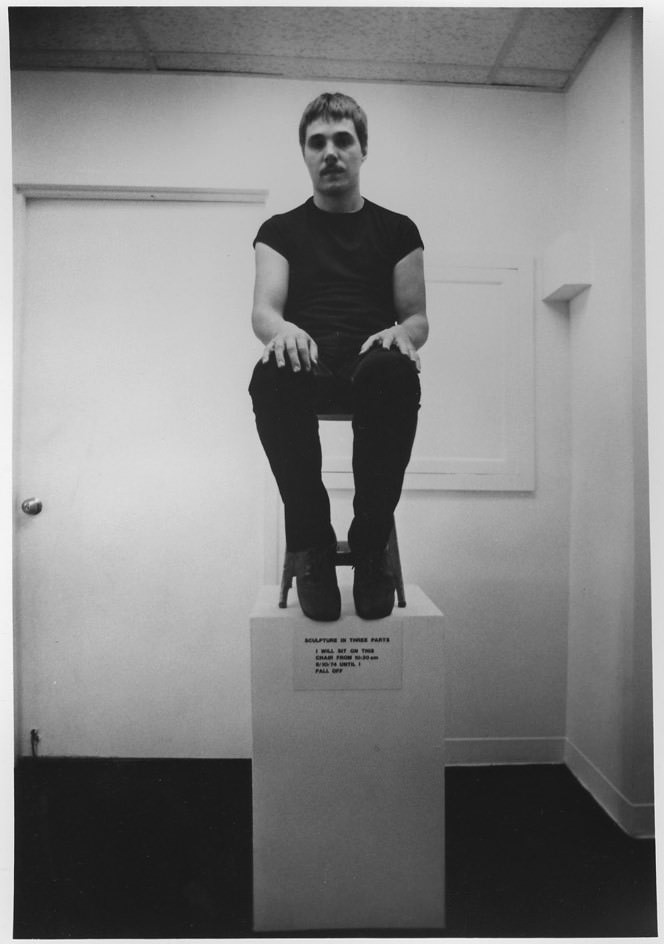
Burden Fails: 220


220, F-Space, October 9, 1971: The Gallery was flooded with 12 inches of water. Three other people and I waded through the water and climbed onto 14 foot ladders, one ladder per person. After everyone was positioned, I dropped a 220 electric line into water. The piece lasted from midnight until dawn, about six hours. There was no audience except for the participants.
The piece was an experiment in what would happen. It was a kind of artificial "men in a life raft" situation. The thing I was attempting to set up was a hyped-up situation with high danger which would keep them awake, confessing, and talking, but it didn't, really. After about two-an-a-half hours everybody got really sleepy. They would kind of lean on their ladders by hooking their arms around, and go to sleep. It was surprising that anyone could sleep, but we all did intermittently. There was a circuit breaker outside the building and my wife came in at 6:00 in the morning and turned it off and opened the door. I think everyone enjoyed it in a weird sort of way. I think they had some of the feelings that I had had, you know? They felt kind of elated, like they had really done something.

- Chris Burden

quote from:

Sunday, December 11, 2005

Human

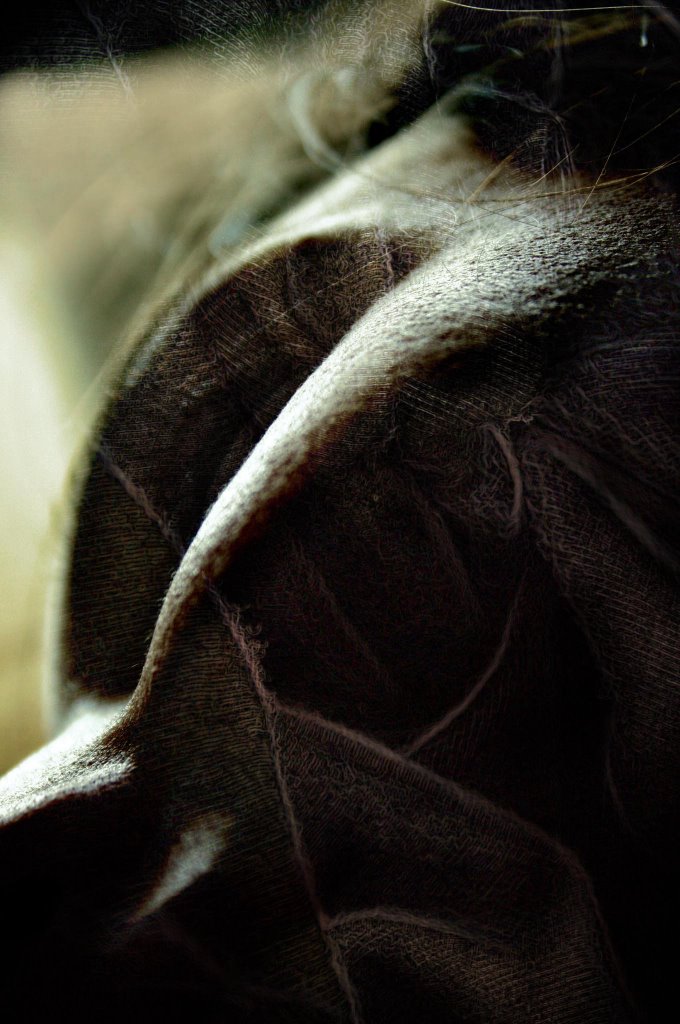
Photo by Francine Gagnon.

Does anyone say he is his body, period?

What is it that makes the body such a scandal? Is it because bodies we see are not our bodies? Is it this un-identity, the fact that empathy seems like a childish dream, some sort of ridiculous belief? Is it that touching is losing my own touch? Listen to Wittgenstein: The truth is: it makes sense to say about other people that they doubt whether I am in pain; but not to say it about myself.
So there is a basic egocentrism in our thinking about the body. In English, we say "take a walk in my shoes". Compare it to the Polish version: "put yourself into my skin". (Strange, how my skin seems to define me.) Is a racer without his car still a racer?
And that's where the fear of skin appears. And the obsession of skin. Its shapes, tones, actions.
How many skins can I have, how distant is this skin from mine, what can be done with this skin. Using it to re-create identity, as a toy, a scandal, or any other pretext. And we all do it - which is scary, and nice : feel the carress. It translates the other into what's yours.
And vice versa.

NB: Here is a short overview of body in contemporary art (in French)

Monday, December 5, 2005

Surface

Untitled (2005)

Artistic residency


Mousonturm is organizing an artistic residency for its Plateaux Festival:

Plateaux is a supportive model for young performing artists.

Plateaux invites international artists, performers and companies in the field of experimental theatre, performance art and live art to send in conceptual proposals. The proposals should display a discrete and textually well founded aesthetic position.

Plateaux commissions a limited number of productions and invites the artists for production residencies. The artists can carry out their respective projects at Künstlerhaus MOUSONTURM in Frankfurt/Main or at one of the co-producing institutions. The productions will then be presented at the Künstlerhaus MOUSONTURM during the Plateaux festival in October 2006.

Plateaux deadline
JANUARY 14 2006 (Postmark)


Sunday, December 4, 2005

Obscene Art #2: For Christ' Sex - Sarah Lucas

Chicken Knickers (1997)
"I was quite a tomboy when I was growing up, I liked hanging out with a lot of boys, and I sort of got used to their way of talking about sex. And at the same time as thinking it was funny, I suppose I was a bit aware that it also applied to
me, and I've always had those two attitudes."
We Do it With Love
"I don't think I have a problem with having more than one view about it at once."


The Stinker (2003)

Got a Salmon on (Prawn) (1994)
Recently you could buy it at Artangel for under 20 000€...


The Kiss (2003)

"I first started smoking when I was nine. And I first started trying to make something out of cigarettes because I like to use relevant kind of materials. I've got these cigarettes around so why not use them. There is this obsessive activity of me sticking all these cigarettes on the sculptures, and obsessive activity could be viewed as a form of masturbation."

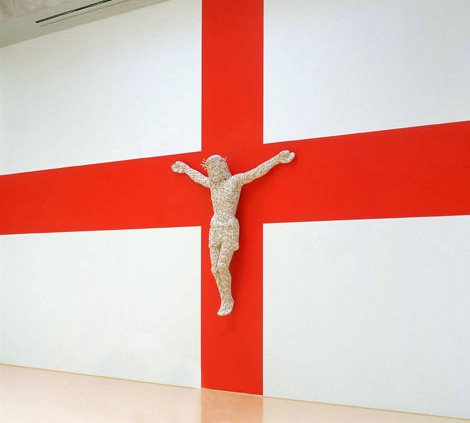
Christ You Know it Ain't Easy (2003)
(link to anarticle about the exhibition here)


Beer Can Penis (1999)

Friday, December 2, 2005

Obscene Art #1: Cutting off the penis

The Polish events, which just keep getting worse and worse, are an inspiration to write about body art and every possible controversial art form I can think of. For now, enjoy some pictures of Paul McCarthy's work:
Here's a free translation of a (fragment of a) recent post about McCarthy's last London show by my friend LunettesRouges:
In a huge abandoned warehouse, models of pirate ships and a few remains of the filming, some heads, arms, swords. This is where Paul McCarthy and his son Damon spent a month filming pirate scenes that are now projected on two sets of screens. It is grotesque, hilarious, carnavalesque, obscene, unsettling, funny, terrifying, violent, perverted, orgiastic, gore, gargantuan. The music is obsessive, deafening. The actors scream, shout, laugh, fight. It's Hollywood and Disney gone amok, perverted, parodied. The pirates attack a village, they kill, rape, torture the prisonners (Abu Ghraib, of course), they sell the girls at auctions. The blood is naturally ketchup, the cut off members are naturally made of plastic, and nothing is done to hide the cameramen or the dummies.

It's a deformed reality, a repulsive attraction, and, if you don't leave disgusted after five minutes, it's a mind-twisting experience.
(all this off-site from the Whitechapel Gallery)

And here's an article from the Guardian, in case you want to know more about the man.
Oh, and since it's the right season. Here's a holiday picture, courtesy the very special mind of Paul McCarthy:
"I am not interested in art being a cure-all." - Paul McCarthy

More: